A recent trip got me thinking. We camped in the very western tip of Maryland and the southwestern part of Pennsylvania, a gorgeous area in the Allegheny mountains.
Partly because of the sites we visited, and partly because I tend to get white-knuckled while driving in the mountains (whether on 15-mph ess curves or on 70-mph I-68 with locals flying by me), the trip got me thinking about how people in the past have transported themselves through their natural environments.
Using Waterways and Roads
A 21-year-old George Washington traversed this area in his race to take midwestern native lands for British Americans before the French did. While scouting the area in 1754, a confrontation with French soldiers became the first battle of what was known in North America as the French and Indian War, which lasted about seven years. At Ohiopyle State Park, I enjoyed a depiction of George Washington trying to navigate the falls and rapids of the Youghiogheny River on a wooden raft. I could see why he apparently wrote it was not passable.
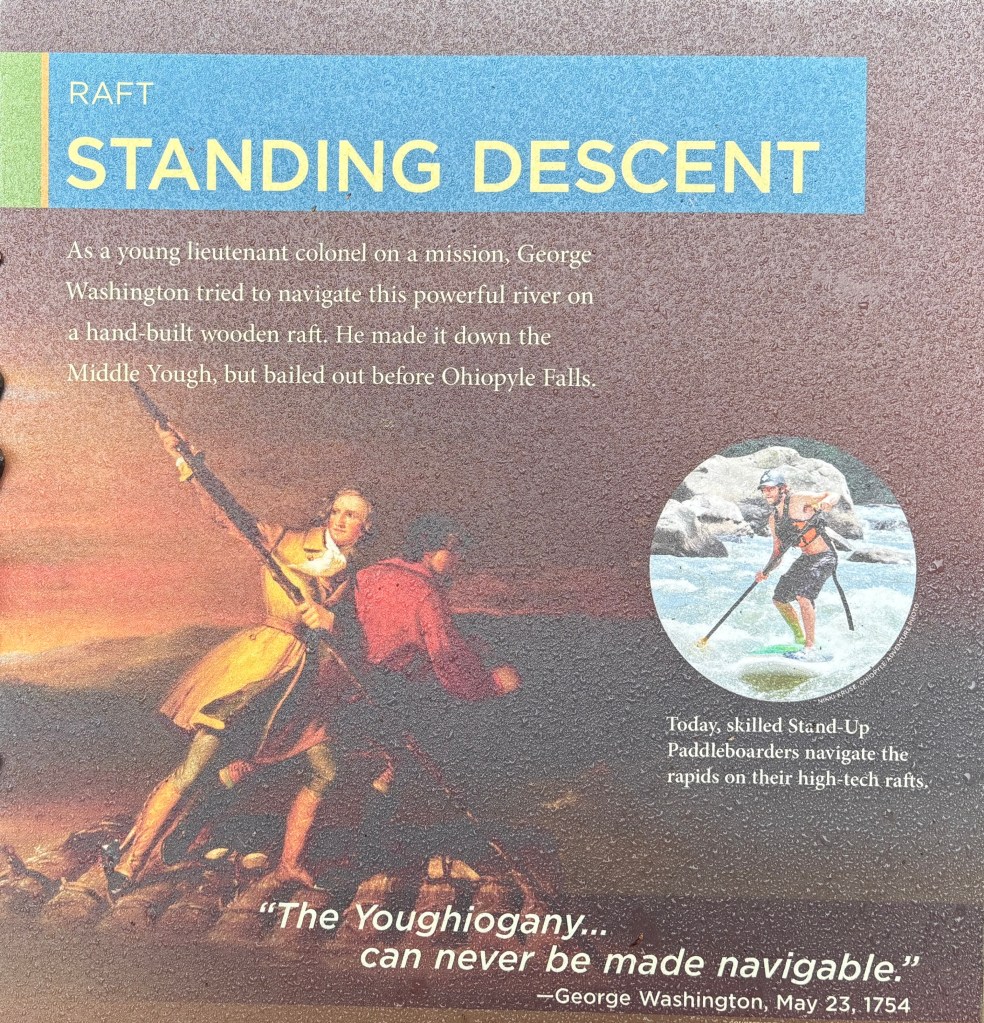
Washington was enlisted by the British army to find a route that would work for soldiers to use and became convinced the new nation should promote road-building. Later, in 1806, Congress authorized the building of a National Road. In effect, this was the first federally funded highway. Made of rocks (broken by hand) and gravel and eventually running from Cumberland, MD, to Vandalia, IL, it was a major improvement over the uneven, rocky, stump-filled, sometimes muddy, and dangerous route that routinely broke wagon wheels and injured animals.
The road promoted settlement of the midwest by making a safer route for wagons and stagecoaches. (This same road eventually became the modern U.S. route 40.) While engineers and laborers deserve credit for its effectiveness, as Jason Smith of Historic Aerials puts it, American colonists did not invent new roads so much as inherit and improve existing indigenous paths.
In the 19th century, Americans also tried to harness the power of water for the transporting of goods through the building of canals. While in Cumberland, MD, we visited the Chesapeake & Ohio Canal National Historical Park and learned that starting in 1828, poorly paid Irish, German, Dutch, and English workers (mostly immigrants) dug through the rock and mud.
C&O Trust
The Canal Trust explains the workers hand cut materials to build 74 different locks and used explosives to bore a 3118-foot tunnel through a mountain in order to facilitate the movement of boats over 605 feet of elevation change between Cumberland and Washington, D.C. It’s not known how many workers died doing the arduous work or while living in the rough cholera-ridden camps.
Lock 5
Photo from C&O Canal Trust
Traffic on the canal was busy, even before all its sections were complete, with boats carrying cargoes of flour, grain, whiskey, and lots of coal. According to the NPS Canal Construction website, in the peak year of 1871, 850,000 tons of coal was shipped down the canal. Still, the originally planned length of the canal was never finished, because by 1842, the railroad had steamed into Cumberland, and it would become the faster and more desirable mode of transportation.
The Costs of Railroads
The building of the railroads had enormous implications, and not simply related to the transportation of people and goods. The federal government provided incentives to railroads for a transcontinental route in the form of massive land grants (over 1.3 million acres in 27 states), along with $64 million in loans. In an interview with the National Museum of American History, Dr. Manu Karuka said the railroad facilitated the colonization of western territories by encouraging new settlements on indigenous lands that Congressional treaties acknowledged as belonging to various indigenous nations.
After the Civil War, General William Tecumsah Sherman saw his top priority as protecting the construction of the railroads, which were crucial to attaining the divinely ordained “manifest destiny” of the United States to expand from the Atlantic to the Pacific. In 1867, Sherman wrote, “we are not going to let thieving, ragged Indians check and stop the progress” of the railroads. At times outright war broke out between native warriors and the U.S. Army and/or American settlers and travelers.
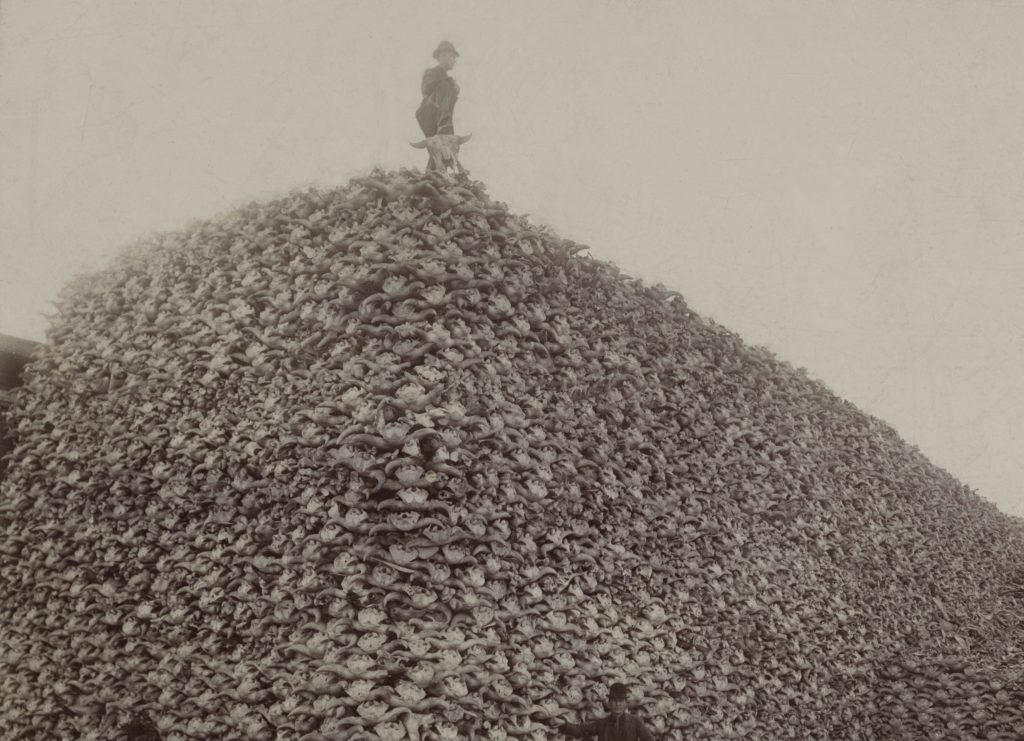
Sometimes war wasn’t necessary, because General Philip Sheridan saw exterminating the buffalo as a way to settle the vexing problem of Indians living on the desired lands. Indeed, the railroads advertised “hunting by rail” excursions, and tens of millions of buffalo were slaughtered by men with rifles. According to the Kearny County, KS Museum, the railroads spelled doom for the buffalo, who were hunted to near extinction. This undermined the livelihood of tribes like the Lakota. Some very poor homesteaders earned a little money collecting bison bones, which were shipped east to be ground into fertilizer, china, and other manufactured goods.
Source: Burton Historical Collection, Detroit Public Library from Wikipedia Commons
Again, immigrant workers paid a high price for the new transportation technology. The National Park Service site asserts that no precise number is available, but likely over 1000 Chinese laborers died building the Central Pacific Railroad.
Dams, Disastrous and Fun
Sometimes Americans used water for recreation along with transportation, and doing that might mean manipulating and damming the natural boundaries of water. For example, Pennsylvania originally built the South Fork Dam to facilitate a cross-state canal system, but eventually sold the dam to Henry Clay Frick so he could convert the 450-acre Lake Conemaugh reservoir into a private resort property for summering wealthy Pennsylvanians like Andrew Carnegie. They formed the South Fork Fishing and Hunting Club.
The earthen dam looked all right, but problems with its construction and with repair of the dam after a couple of failures caused it to be vulnerable. In addition, the stripping of trees from the steep nearby hills and developers’ narrowing the riverbed to assist industry and housing made annual spring thaws and thunderstorms even worse.
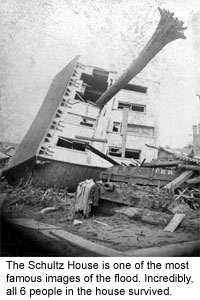
In 1889, after days of heavy rain, including 10 inches in one day, the dam failed. Within an hour, 20 million tons of water emptied from the lake, rapidly flooding the communities in the valley. In Johnstown, an industrial town 14 miles downstream, a 40-foot high wall of water sped along at an estimated 15 miles per hour, catching many people unaware and destroying almost everything in its wake. The wall of water included debris like houses, barns, animals, and people. Debris piled 40 feet high at a railroad company’s stone bridge and then caught fire.
The sudden, awful catastrophe killed an estimated 2200 people, including 99 entire families in what became known as the Johnstown Flood. Bodies were found many miles downstream, and many never identified. Some people miraculously survived by clinging to trees or houses that were rushing down the water. Although many locals blamed the South Fork Fishing and Hunting Club for failing to maintain the dam properly, in court the club successfully argued that its failure was a natural disaster, and the survivors never received any compensation.
In the first major relief effort of the newly established American Red Cross, Clara Barton and 50 volunteers arrived to provide free lodging, food, and medical care for the victims of the flood, including tens of thousands who were homeless.
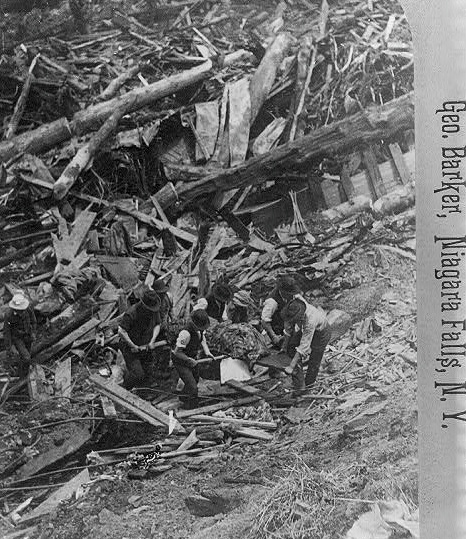
Photo credit: Geo. Barker
Library of Congress Prints and Photographs
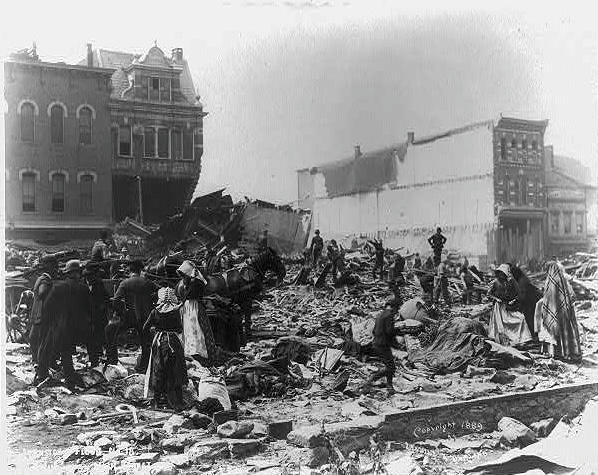
Credit: Langill & Darling
Library of Congress Prints and Photographs
I’d like to think that engineers are more effective these days and that there are more safety regulations for public projects. We have stayed at numerous Army Corps of Engineers Campgrounds, and as campers, found them to be clean and well-run. At Outflow campground in Confluence, PA, we watched in amazement as water pumped from the dammed Youghiogphey River Lake rose up a couple of stories high from below an earthen dam into the Youghiogphey River. Check out this video of the pumped water!
We walked above the dam and chatted with a nice ranger, who told us that locals appreciate the project. Those above the dam enjoy boating on the lake, and those below (especially the rafters and kayakers and the businesses that rent boats and innertubes) love the whitewater on the river near Ohiopyle, PA. The dam also creates power for electricity, enough for about 4000 households.
Modern engineering projects aren’t always successful, however. “9 Times the U.S. Army Corps of Engineers Miscalculated Badly at the Expense of Taxpayers, Wildlife” describes some massive Army Corps of Engineers projects that have drawn criticism for failures, unintended consequences, environmental problems, and huge delays and cost overruns. These include the New Orleans levee system, which in 2005 did not contain flooding from Hurricane Katrina and killed almost 1400 people.
Although a lot of freight still moves by rail, the federally funded interstate highway system means people now tend to move by car rather than railroads. Americans love crossing the country quickly in their own vehicles, and the motels, gas stations, and fast food restaurants that arose with the highways made that even more comfortable. As for canals, they are no longer functioning.
Reimagining and Reusing
So what to do with the disused railways and canals? Repurpose them as multi-use trails! Far-sighted and civic-minded people – volunteers, often with little or no government funding but with much patience and organizing ability – have developed rail trails in communities all over the U.S. They are used by bikers, runners, walkers, people pushing strollers, roller bladers, wheelchair users, and horseback riders. The Rails to Trails Conservancy reports there are now over 42,500 miles of trails bringing visitors to local communities and their businesses and bringing joy to users.
On this trip, we rode our bikes on three rail trails. Twice, we rode on the Western Maryland Rail Trail starting in Hancock, MD, where we saw limestone and the Potomac. It’s 28 miles long and paved (!) and was our favorite. The GAP (Great Allegheny Passage) runs 150 miles from Cumberland, MD, to Pittsburgh, through mountains, valleys, tunnels, and woods; we rode a small lovely section starting in Confluence, PA. Finally, we rode on the Lower (rhymes with flower) Trail that runs 17 miles, often alongside the Juniata River.
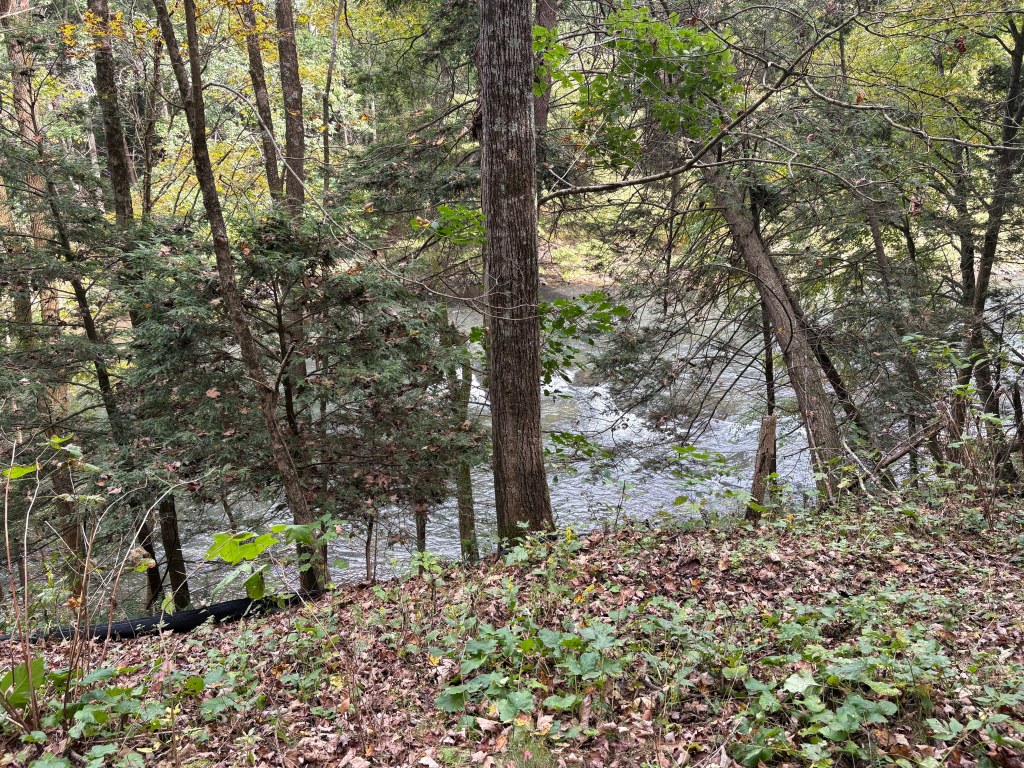
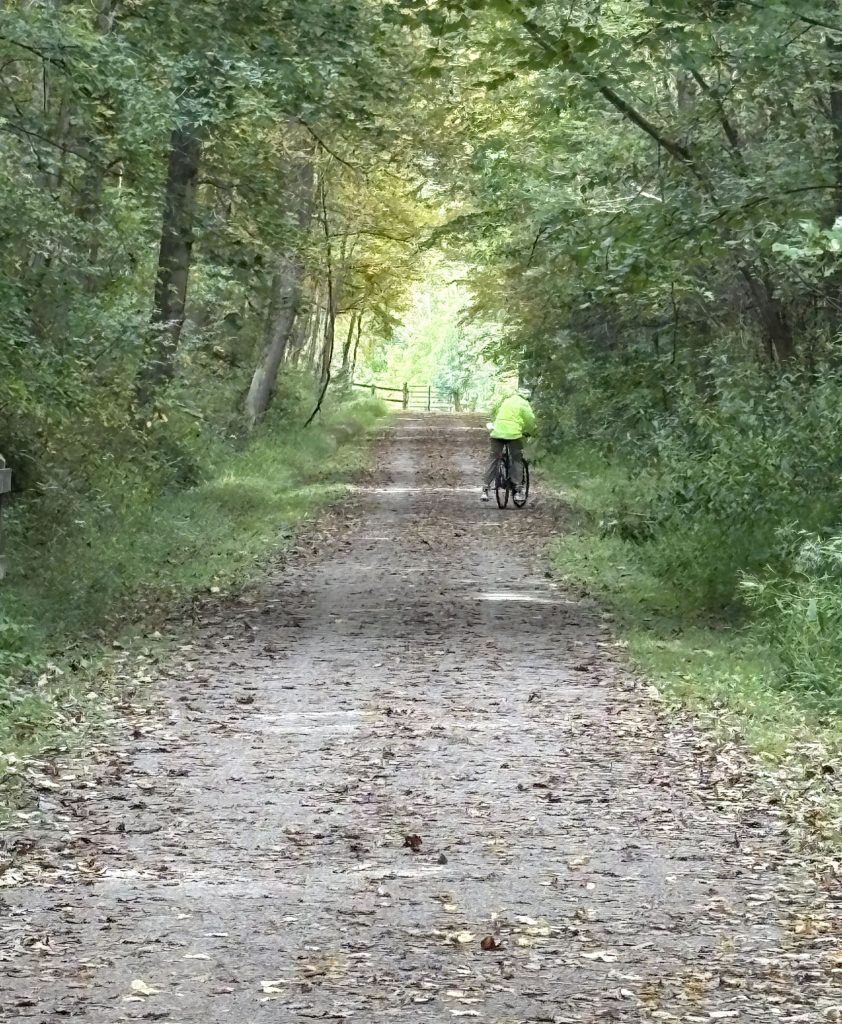
These trails were very flat – after all, the railroads tried to forge routes that had little elevation gain for the heavy trains to climb – and that makes a difference for occasional bikers like us. We encountered other friendly riders along well-maintained, peaceful, and beautiful trails.
Conclusion
The history we encountered on this trip made me think about human motivation and grit, including the toughness required to cross mountains, ford rivers, and build roads, canals, and railroads. The motivations of the settlers, businesspeople, and laborers involved were likely somewhat different, and some people probably cared about the implications of new transportation technology on others (natives, workers, animals, the environment) while others did not.
Which of the technologies should be considered “advancements”? Or more realistically, since the past was complex, what were the benefits of each of them, and who benefitted? Who lost out? Did the innovations simply go chugging along like an out-of-control train, or did the nation’s leaders make a sustained effort to see where the balance of costs and benefits lay?
I thought too about which new efforts the government supported, incentivized, and regulated, and which ones they didn’t. This seems especially relevant today with green technologies (like solar and wind energy, hybrid and electric vehicles) that were supported by previous administrations now being nixed for reasons that don’t make sense to me given the damage of climate change. Of course, there are also many questions to be answered about if and how to regulate AI as we rapidly need to ascertain the risks along with the benefits.
After raising questions that deserve more nuanced answers than I’m providing, I’ll say one thing that I’m 100% sure of: rail trails are a great idea.
Thank you to May Theilgaard Watts, the naturalist and educator who apparently was the first person to think of turning an abandoned rail line into a trail. And thank you to all the grassroots Americans who have created so many trails and made our enjoyment possible.
Read other people’s trail stories, which might just inspire you to ride.


