A recent message from Annie Evans of New American History encouraged educators to bring history alive in their lives with a spring break trip to a historic site. Although I’m now retired from teaching, I did that by visiting three amazing African American Legacy sites recently created by the Equal Justice Institute.
The first site, The Legacy Museum, founded by Bryan Stevenson, originally opened in 2018 . An expanded version later reopened in a former cotton warehouse in Montgomery, Alabama, where enslaved people were forced to labor.
We walked to the museum through the Legacy Plaza across the street, a lovely flowered site where one can sit and enjoy statues of MLK, Rosa Parks, and John Lewis.
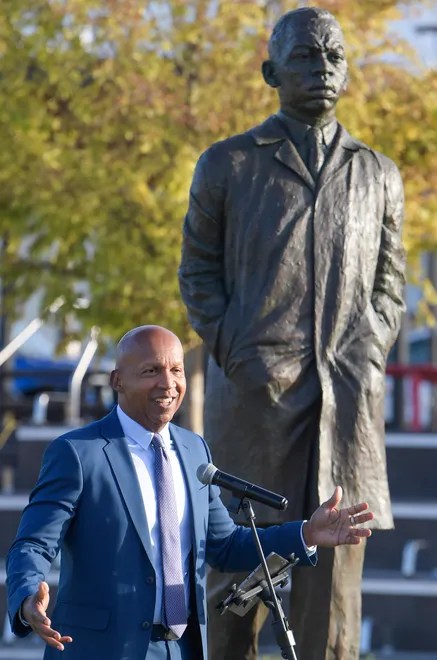
Photo: Mickey Welsh, Montgomery Advertiser, Nov. 12, 2024.
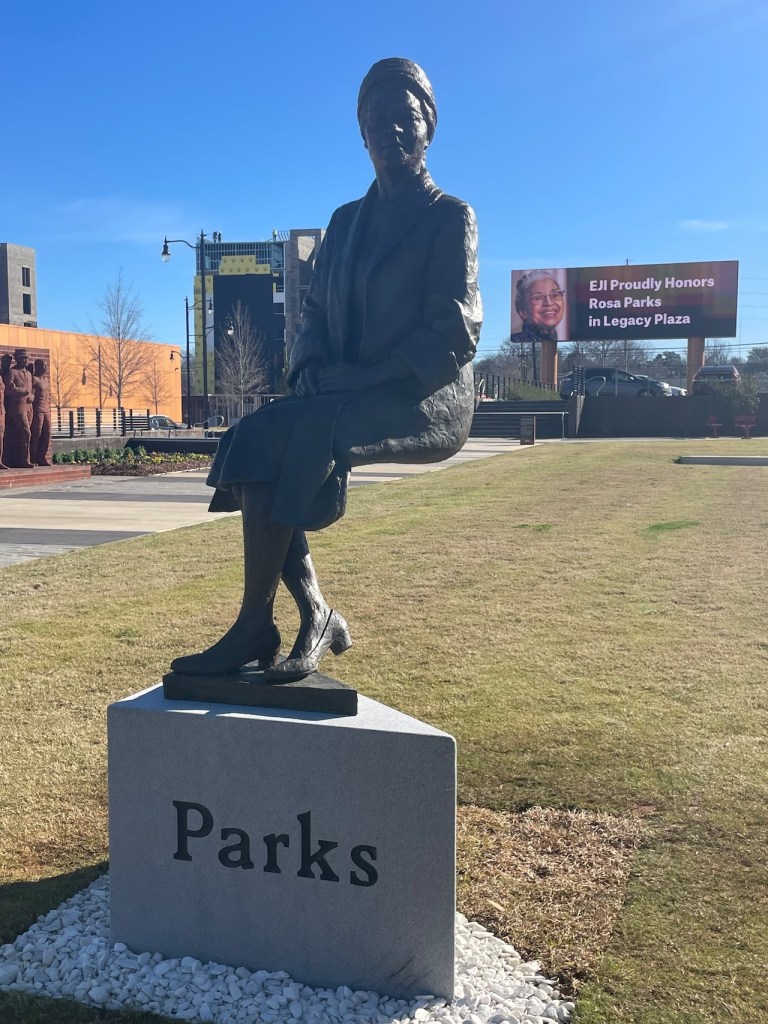
Photo: Savannah Tryens-Fernandes
Inside the museum, we were greeted by very helpful and welcoming staff members, but soon walked into rooms dramatically portraying the Middle Passage, the gruesome trips on crowded, disgusting ships for the long dangerous trip imposed on millions of Africans from west Africa to the Americas. All the captured people suffered, and many died on the voyage. Information was shared in many ways – textual narrative, maps, diagrams of ships, dots visually showing the massive numbers, audio, video, etc.
Room after room then related different aspects of slavery – with lots of clear evidence from advertisements posted by enslavers who were offering rewards for escaped slaves, excerpts from slave narratives, and postwar ads placed by formerly enslaved people who were hoping to find family members they had been separated from. Ads and early photos documented punishments enslaved people suffered for behaviors such as not showing up on time or leaving without permission to visit family at neighboring plantations.
Subsequent portions of the museum showed the timeline of Reconstruction (the post-Civil War period), when hopes rose due to the 14th and 15th Amendments. However, those hopes were dashed by the rise of the KKK and other terrorist groups who were trying to reestablish white supremacy in all areas of Southern society, and the fact that the nation (i.e., the Supreme Court, Republican Party, Northerners, etc.) allowed that to happen.
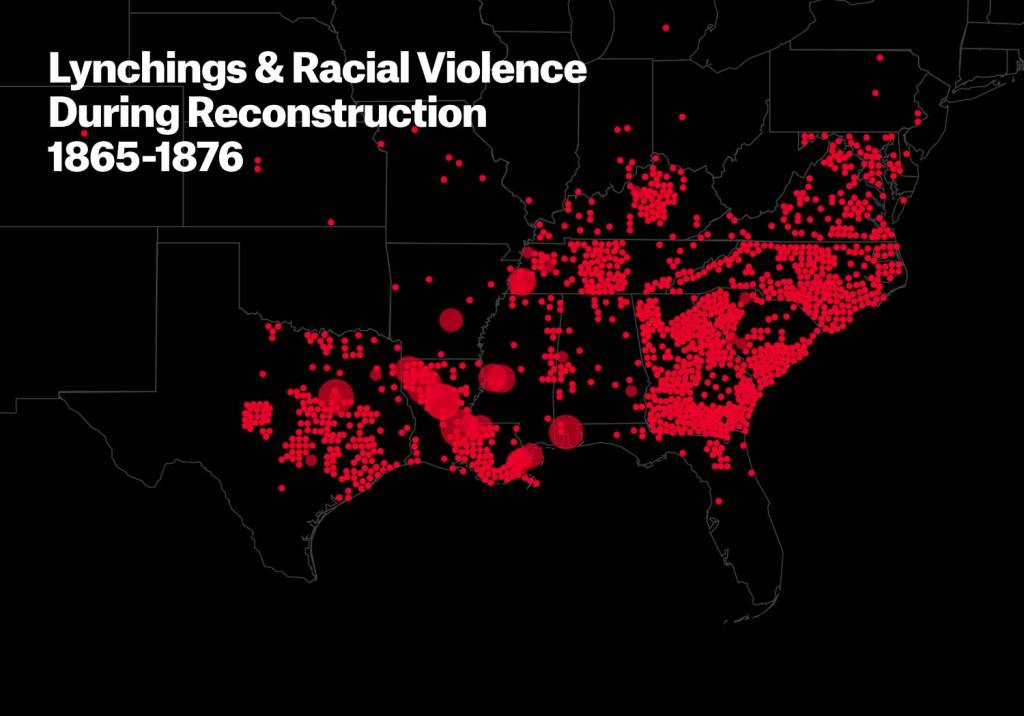
There’s a large section dedicated to the facts and horrors of lynching – which was mob action bypassing the courts to punish African Americans who did not “stay in their place.” As shocking as it is to imagine such a phenomenon, at the time the murders were widely known. The museum showed newspaper stories and photos of spectators who posed, smiling, with the tortured victims of murder. If you have a strong stomach and want to see evidence of that, I recommend the book and website, Without Sanctuary: Lynching Photograpy in America.
We watched a short video about a family whose ancestor was lynched and the impact on the whole community. Stevenson encourages communities to face the fact of the lynching, talk about it, and remember it. He wants the affected African Americans to be seen and heard and for the traumatic impacts to be acknowledged.
Participants at the community events collect dirt from sites of the lynching, and in the museum are hundreds of jars of dirt (red, brown, black, sandy) from other lynching sites around the country, each jar with the name of the person lynched there.
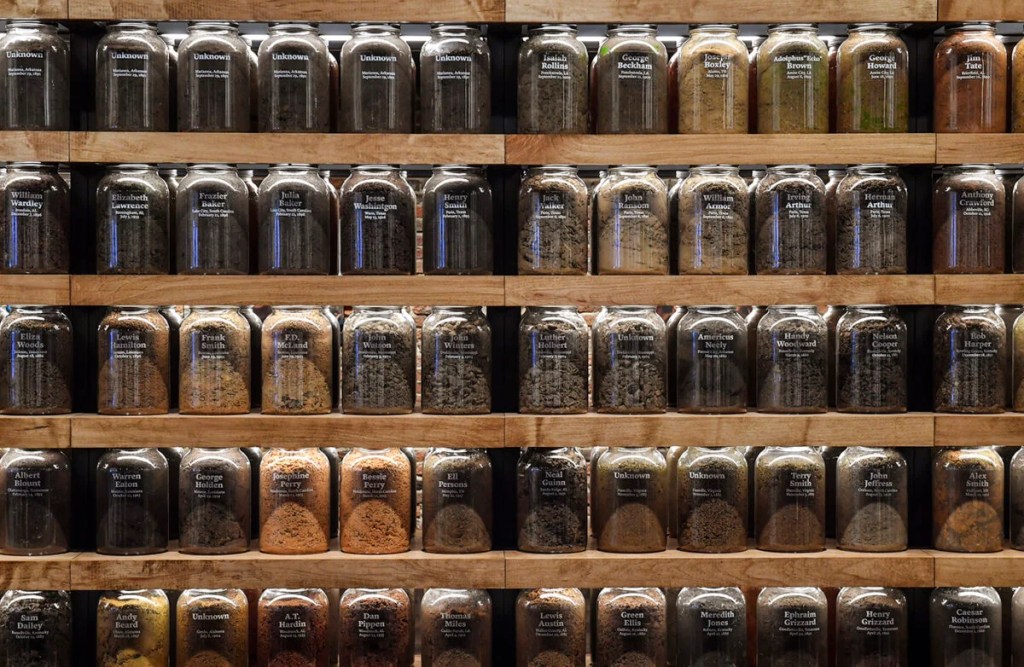
Photo by Ricky Carioti/Washington Post. Yes! Magazine story
The museum draws a through line connecting centuries of hateful racial ideology. The myth of Black inferiority helped justify slavery for two hundred years and then that same myth persisted in many white minds for a century or more after slavery was abolished, justifying segregation, economic discrimination, and all sorts of other cruel treatment, including violence against civil rights activists.
The museum links the racial ideology and its consequences to problems today, especially the criminal “justice” system tragedy in which African Americans are imprisoned at much higher rates, receive longer sentences than whites for the same crimes, and where one third of Black males will be jailed at some point in their lives. Some police treat Black suspects with violence, and many white Americans assume black criminality so that African Americans are presumed guilty instead of innocent. The exhibit’s theme is “Enslavement to Mass Incarceration.”
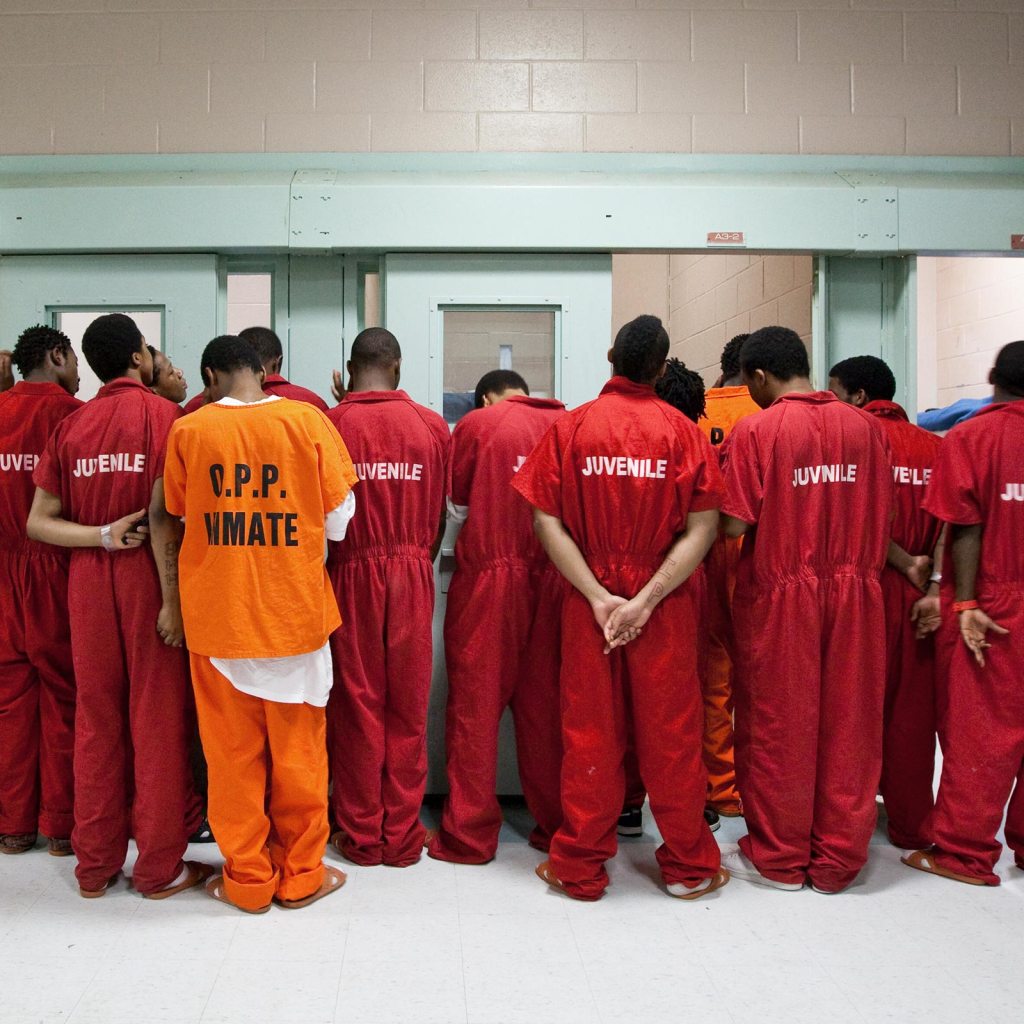
The museum stresses this through line in part because of the Equal Justice Institute’s mission to face the past honestly so that there can be justice and reconciliation. It wants people to recognize – and help change – the horrors of the prison system in the U.S., including the harmful practice of condemning children to long sentences imprisoned with violent criminals, the persistence of the death penalty, and so many people jailed for drug offenses.
We spent over 3 hours in the museum and it was emotionally exhausting – even for someone who taught this history for decades. I was very impressed by the research base and the varied types of presentation of information. I was also struck by the direct, frank language that was used – about cruelty, injustice, etc. – and how the current presidential administration would not be comfortable with that.
I’m very glad that the Legacy sites are privately run as opposed to being publicly funded like national historic sites or the Smithsonian Museum, so that the museum’s historians can be free to speak the naked truth without fear of repercussions. I am sad that our national museums and sites can’t do that at the moment.
In terms of negatives, I thought many historians of African American history might have wished that there was more about slave resistance, major and minor, resilience, community, institution-building, protest, and other ways AA were actors rather than simply victims of oppression (besides during the civil rights movement, for which there’s a pretty good section). There was a little more of that at one of the other Legacy sites, the Freedom Monument Sculpture Park, but probably not enough to please some students of history.

After lunch we drove to the boat launch for the (free) 15-minute river boat that would take us to the monument park.
Visitors stroll paths featuring sculptures by artists about the losses suffered by indigenous peoples, the rich cultures of Africa before enslavement took its toll, and portrayals of aspects of slavery (shackles, family separation, love, etc). There are also 2 original cabins where enslaved people lived.
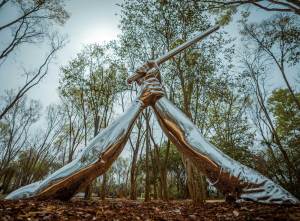
We were impressed by Bryan Stephenson’s taped narration to and from the park on the pleasant boat ride on the Alabama River. It contextualized slavery in Alabama and reminded us of the dearth of memorials to African Americans compared to the vast number of Confederate memorials. It mentioned Alabama’s state holidays that include Jefferson Davis’s birthday and Confederate Memorial Day; MLK Day is shared with Robert E. Lee’s birthday.
The next day we visited the third of the Legacy Sites, The National Memorial for Peace and Justice. Its goal is to commemorate the U.S. race-based lynchings between 1877 to 1950. The names of more than 4400 individuals are engraved on more than 800 corten steel monuments, one for each county where a racial terror lynching took place. The Institute’s researchers have uncovered many more lynchings that had been previously known.
Along both sides of one section of monuments were numerous descriptions of the justifications given for why some individuals were killed. The visual representation of the number of lynchings of African Americans that took place is powerful. The photos we took do not convey it.
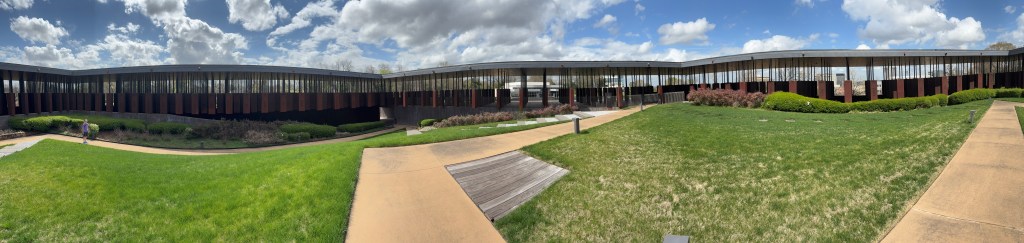
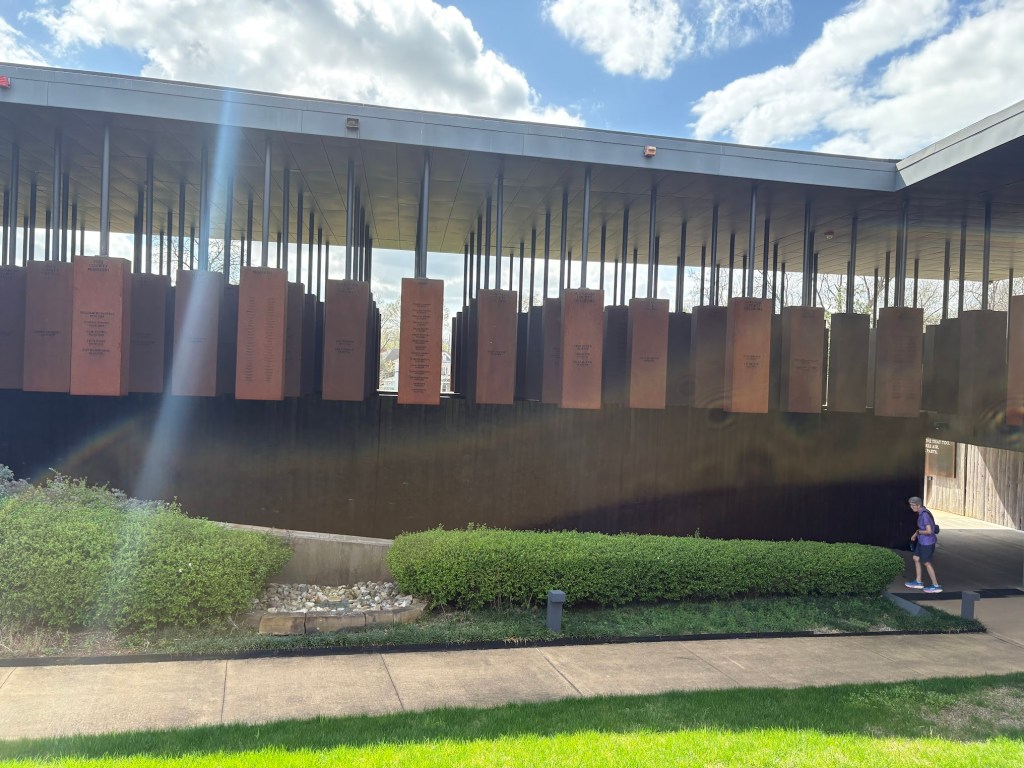
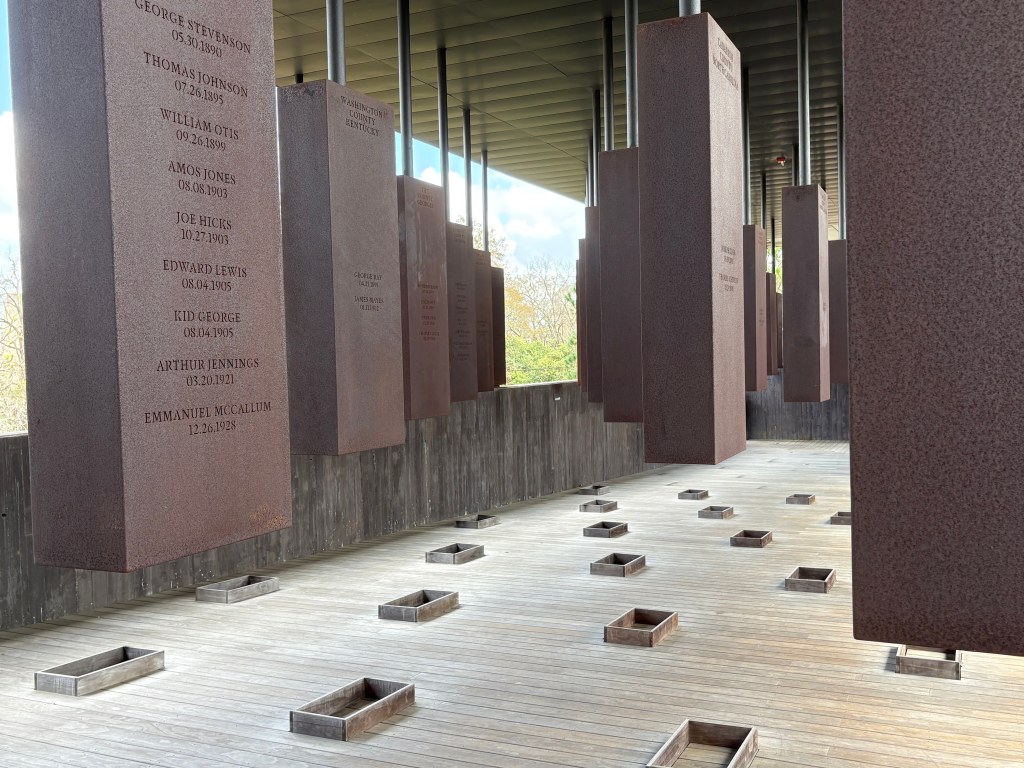
It’s difficult to slowly and somberly read the brief accounts. Often the victims were Black men accused of something like living with a white woman, or behaving disrespectfully like not calling a police officer “sir” or not stepping off the sidewalk when whites walked by. Occasionally someone had been accused of theft or assault. If you imagine that in a few cases the person lynched had actually committed a crime, surely letting the racist criminal justice system of the time take its course would have resulted in punishment (though probably not death). Clearly the point of a mob impatiently murdering someone was to send a very public terrorizing message to the Black community that stepping out of place would not be tolerated.
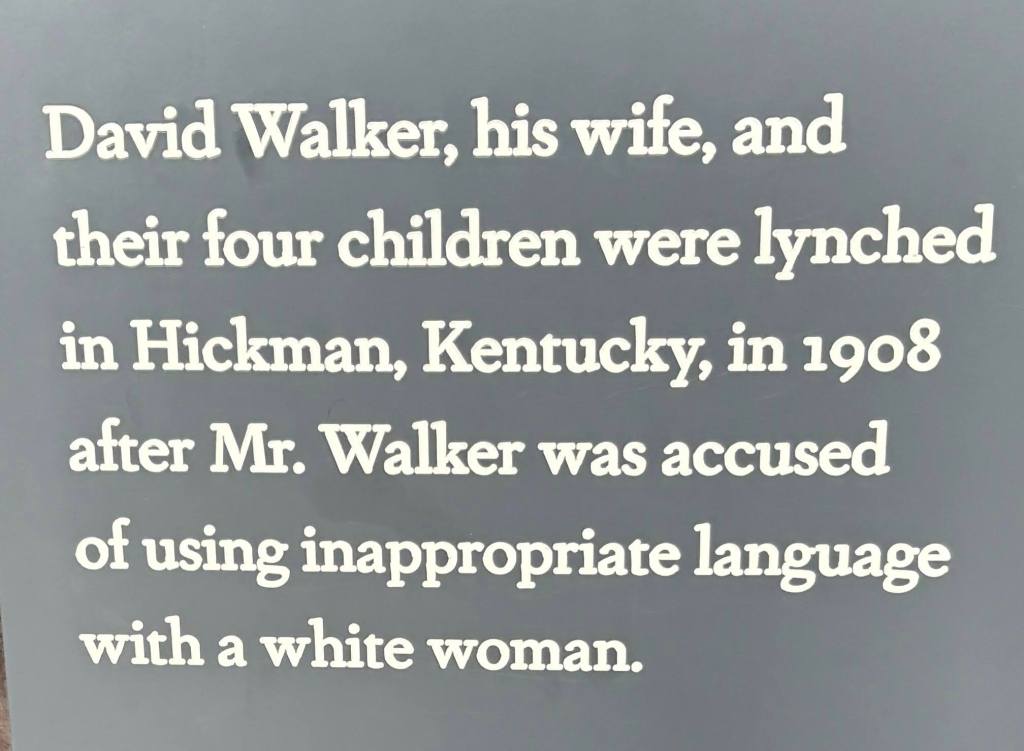
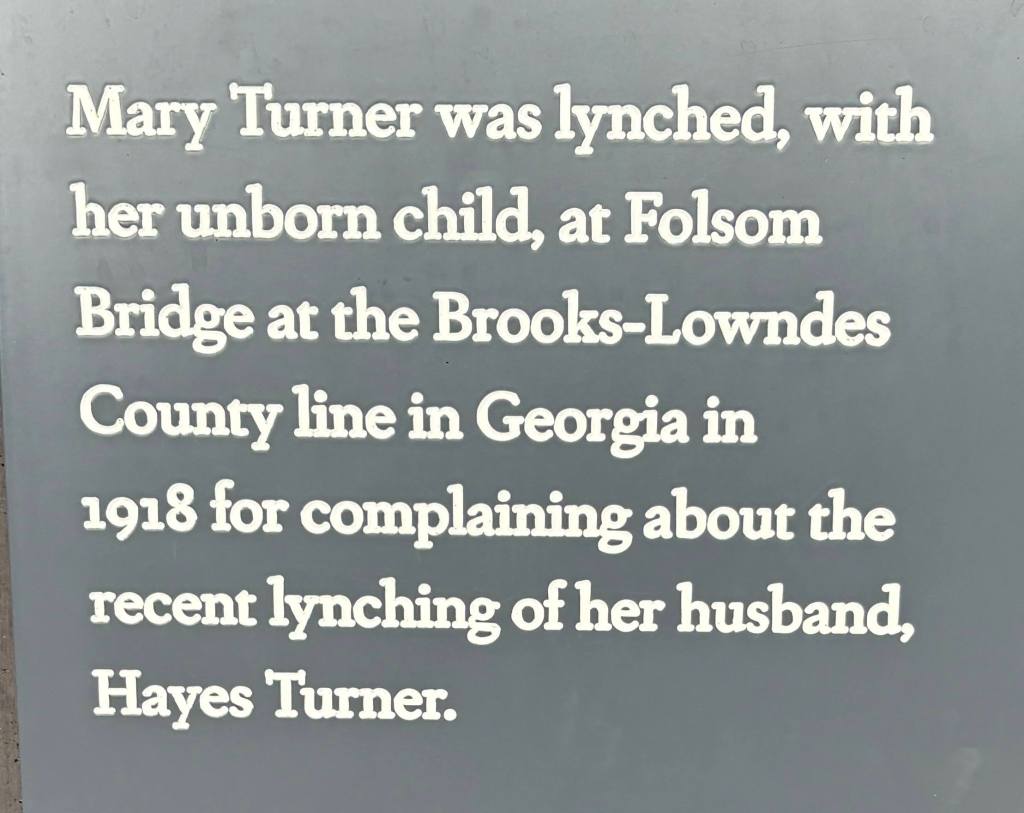
As upsetting as the monument is, it ends with a section that is more uplifting. Markers celebrate hundreds of coalitions that have partnered with the Equal Justice Institute to install historical markers in their local communities.
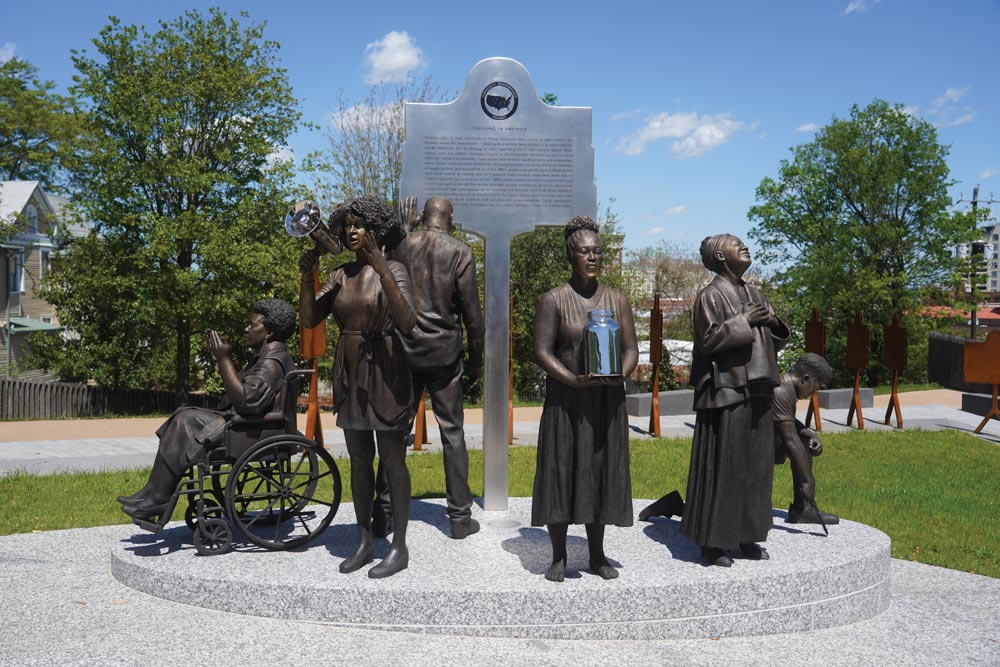
To be inspired by the potential of activism to change entrenched and oppressive practices, one can also visit other civil rights sites in Montgomery, such as the Rosa Parks Museum at Troy University. One can also read Stephenson’s book, Just Mercy, to understand his Institute’s efforts to represent children and adults illegally convicted or unfairly sentenced, improve prison conditions, and end mass incarceration.
I have no idea how Bryan Stephenson did such effective fundraising so that admission to visit all three sites is just $5.
Some don’t see the point of such sites because they cause discomfort, especially among white Americans. Asked in an interview with NPR if the Legacy sites are trying to “punish America” by talking about slavery and lynching, Stevenson pointed to the progress made in South Africa after the end of apartheid and Germany’s reckoning with the Holocaust. He sees grappling with the ugly legacies as a crucial step in a path toward a better nation.
“There is an America that is more free — where there’s more equality, where there is more justice, where there less bigotry — and I think it’s waiting for us,” Stevenson said. “But I don’t think we can … create that America while we remain burdened by this history that too many refuse to talk about…. You can’t get the beautiful ‘R’ words, like redemption and reconciliation and restoration and repair, unless you first tell the truth.”
 Mary Jo Festle